.
Aesthetics101 (2019-2020)
.
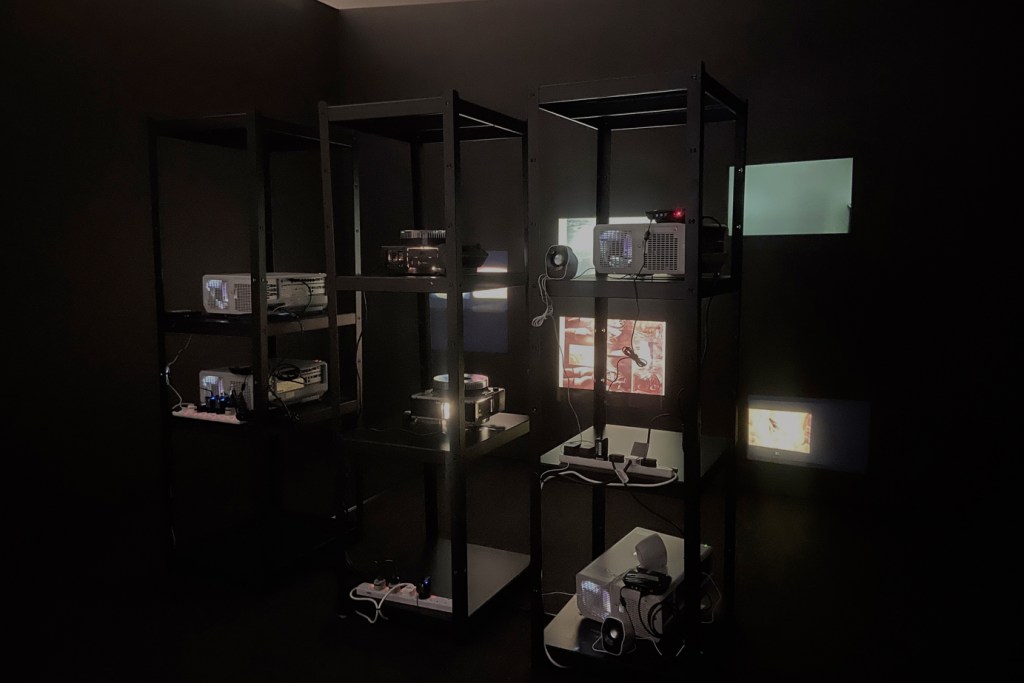
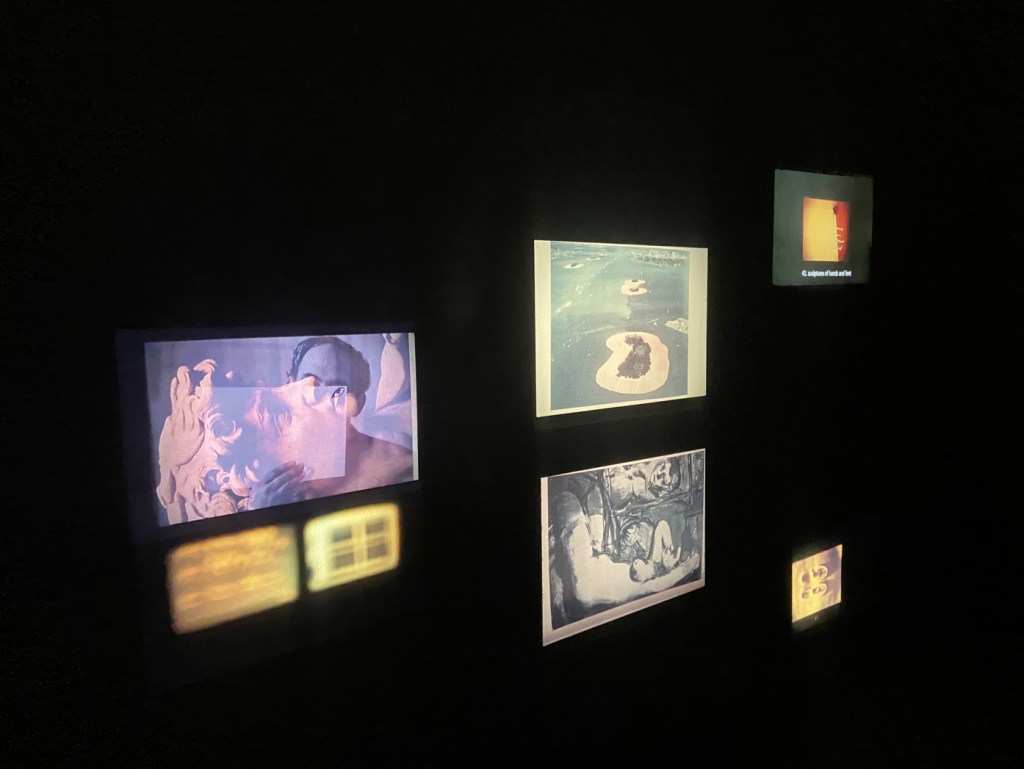
from exhibition “Every Step in to the Right Direction”, Singapore Biennale, Singapore.
3 slide projectors( auto timer), digital projectors and slides on tables with magnifiers.
.
.
The project is based on Prapat’s discovery of over 7,000 educational film slides produced by Assoc.Prof Somkiat Tangnamo, the former Dean of Faculty of Fine Arts, Chiang Mai University, and the founder and the former president of the now defunct Midnight University. The film slides were found in an old file cabinet at the Chiang Mai University along with over hundreds pieces of translated articles used as teaching resources on the Midnight University’s website.
These film slides are the photographic reproductions of western textbooks used for teaching on university’s level in Thailand in 1990s. As educational media has become digitized, old-school teaching media such as film slides, as well as paper-based documents in the storage room, became obsolete. Educational film slides and translated articles on aesthetics and art history were once a premier educational media and play a key role as students’ knowledge base. As such, Aesthetics 101 perceives these obsolete media as a key to explore the history of art education in Thailand.
Aesthetics 101 seeks to transform art pieces by means of printing and photographic processes (sides and photograph), as well as various forms of reproduction. The main concept is to highlight the fact that the original art pieces were photographed and published in these textbooks. These textbooks were then photographed into film slides and projected through a slide projector. Each step of media transformation triggers a change in the original three-dimensional art works; from three to two dimensional images in the textbooks, and finally to two dimensional images on the film slides perceivable through a projector. This phenomenon is further complicated by the adoption of digital media in place of analogue media. Based on preliminary findings, the artist found out that, to ensure translation efficiency, Assoc. Prof. Somkiat initially translated many educational documents with an aid of a certain software and then added further adjustments of his own, resulting in English grammatical structures that are difficult to understand. Discrepancy on different levels as a result of translation from one language to another is unavoidable, and Aesthetics 101′ s aim is not to point out and correct these discrepancies, but rather to consider Somkiat’s translations as one of the historical documents worthy of re-examination as a mean to understand the western art teaching process in Thailand.
.
© Singapore Art Museum
An installation from exhibition “Every Step in to the Right Direction”, Singapore Biennale, Singapore.
.
.
…………………………………………………………………………………………………………………………..
.
.
.
Non-chronological history (2019)
.
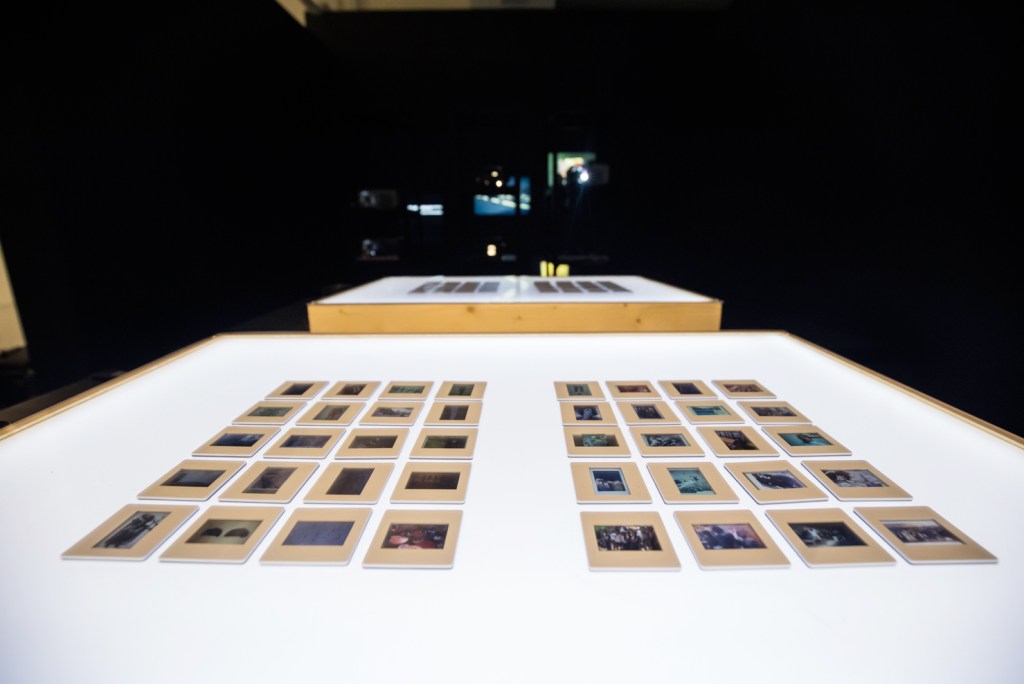
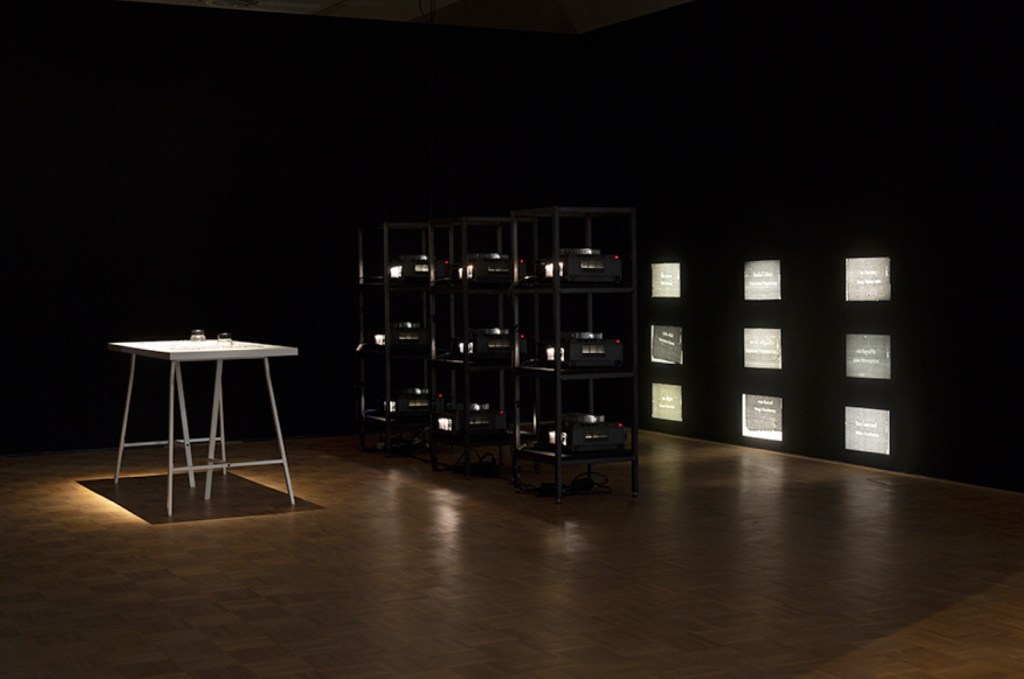
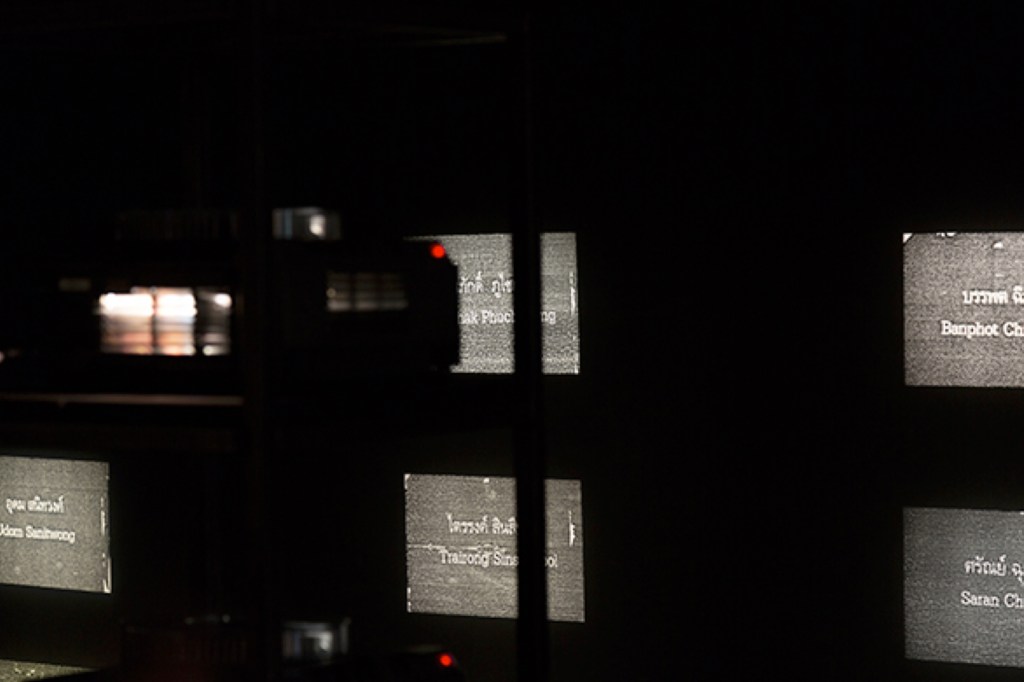
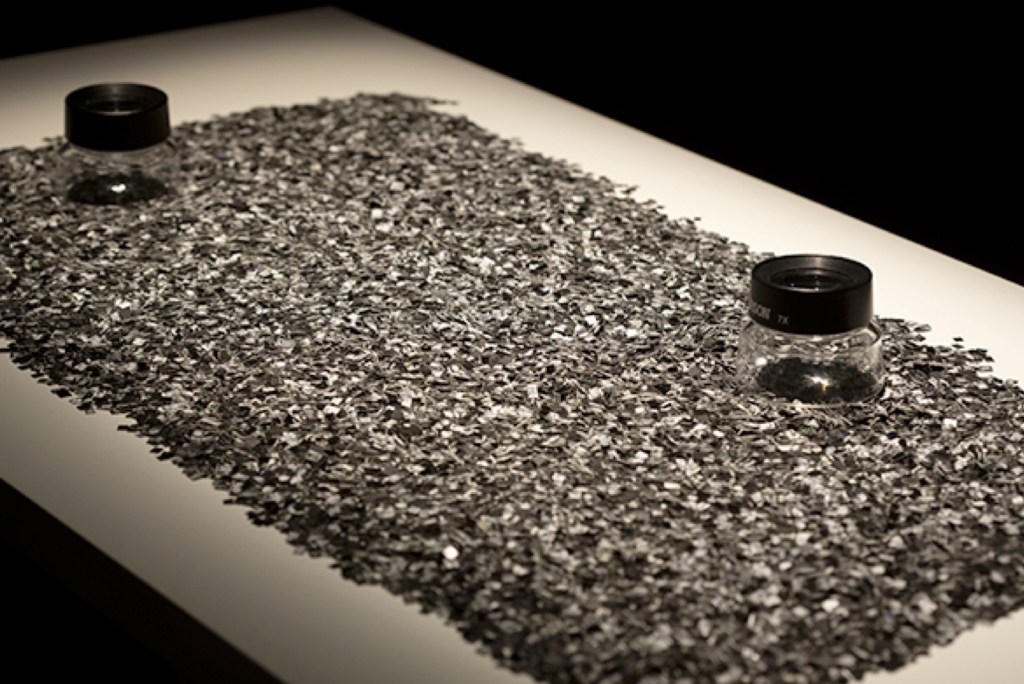
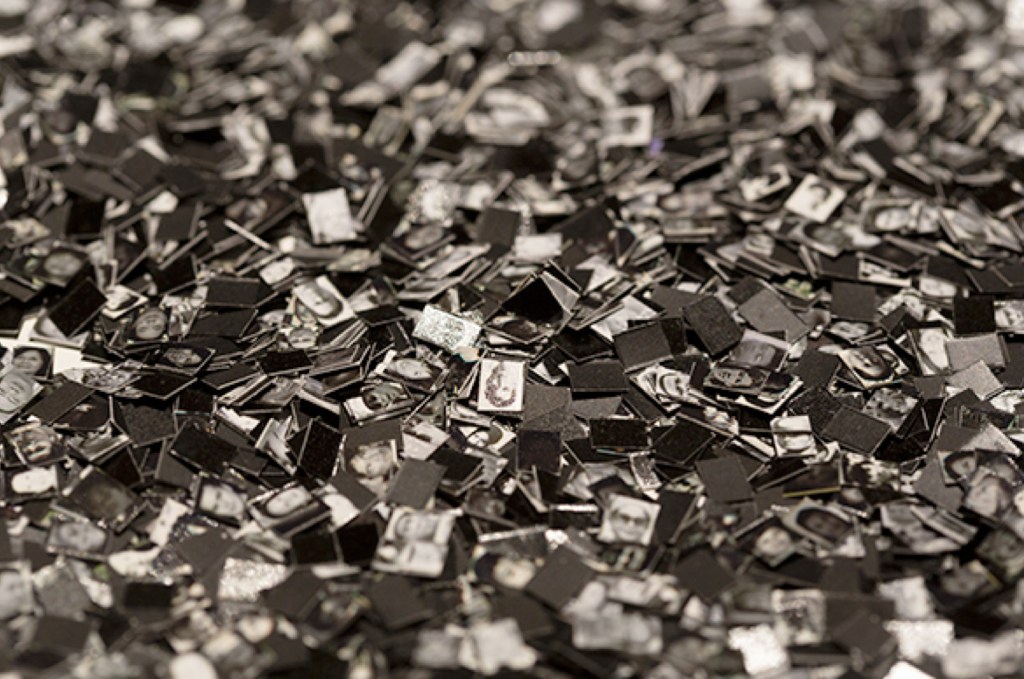
from exhibition “Blackout”, Kunsthal Rotterdam, Rotterdam, Netherland.
9 slide projectors( auto timer), tiny photographs on table with magnifiers.
.
.
In Thai history, every incident relates to each other. There is always a cause and an effect for every incident. One incident leads to other, and leads to other. These series of causes and effects have created many overlapping areas of times, spaces, statuses and persons. Each element is always tied up and intertwined with one another. The interweave of things transforms into a chaos. The chaos, which situates in the same plane but in different class and status, is too difficult to unravel.
In these film slides, all the persons’ names are deprived of their titles and ranks. Only original names and surnames are left to appear within the same frame. No one has title and rank on his/her name to symbolize the class gap, which is the most important issue in Thai social structure. This is what I expect to see in this country.
The point is, to understand the causes and the effects in each period; we need to deconstruct the past and the present from various overlapping elements. Then, we may find the real structure of causes and effects that has an impact on the present time, and we may reach the truth in our national history. This work is similar to a timeline of the history of Thailand. However, the timeline is unchronological. It also strips of a rank, a position and an importance of each player in the Thai political history since 1932. Since the past has an effect on the contemporary, the people in the past inevitably relates to the people in the present. Sometimes it is like a recreation of the memory which intertwines reality with fiction, and it is too difficult to separate both of them. Moreover, the relationship of the past and the present is told through the change of the analog era to the digital era. Though the mediums and the characters are different, there is something that happened, and repeats itself.
.
.
©Tomas Mutsaers
An installation from exhibition “Blackout”, Kunsthal Rotterdam, Rotterdam, Netherland.
.
.
.
.
 LIGERN'S Portfolio